
Introducing AcademiaOS: The Power of Machine Learning to Transform Academic Research
Discover how AcademiaOS leverages large language models to automate and enhance academic research processes, from coding interviews to theory-building, revolutionizing scholarly inquiry.
Introducing AcademiaOS: The Power of Machine Learning to Transform Academic Research
In academic research, the traditional processes often entail a rigorous and time-consuming engagement with extensive scholarly materials. Researchers find themselves delving into a plethora of academic articles, meticulously coding interview transcripts, and extracting insights from diverse case studies. This process, while thorough, is undeniably labor-intensive and prone to human bias. However, an innovative approach is emerging to revolutionize this paradigm: AcademiaOS, a platform leveraging the capabilities of large language models (LLMs) to automate and enhance tasks traditionally performed by human researchers.
AcademiaOS Platform
AcademiaOS: A Synergy of Automation and Human Expertise
Our cofounding partner Thomas Übellacker developed and released AcademiaOS as a web platform designed to streamline and augment the academic research process. Tasks like coding interviews, aggregating dimensions for theory-building, and understanding complex relationships between theoretical constructs can now be performed with drastic efficiency gains using AcademiaOS.
At its core, it employs OpenAI's large language models, aiming to reduce manual effort, accelerate the research lifecycle, and diminish human bias, all without compromising on the quality of outcomes. The platform operates with a high degree of data confidentiality, ensuring sensitive research materials are processed locally.
Addressing Critical Research Challenges
Academic research faces several persistent challenges that AcademiaOS directly addresses:
Time Constraints: Traditional qualitative analysis can take months or even years to complete. Researchers often spend countless hours manually coding transcripts and documents, creating bottlenecks in the research pipeline.
Human Bias: Despite best efforts, human researchers inevitably introduce subjective interpretations and unconscious biases into their analysis. This can affect the reliability and validity of research findings.
Scalability Issues: As datasets grow larger, manual analysis becomes increasingly impractical. Researchers may be forced to limit their sample sizes or invest significant resources in additional personnel.
Consistency Challenges: Maintaining consistent coding standards across large teams or long-duration projects presents ongoing difficulties, potentially affecting the integrity of research outcomes.
The Mechanism of Transformation: A Five-Step Process
AcademiaOS employs a sophisticated, systematic approach to transform raw research materials into actionable insights through five distinct phases:
1. Data Ingestion
AcademiaOS facilitates the upload of text-based documents in formats like PDFs, JSON, or TXT including academic papers and interview transcripts. Scanned PDFs are turned into machine readable text by employing OCR technology.
The platform supports a wide variety of input formats, ensuring compatibility with existing research workflows. Advanced preprocessing capabilities handle various document types and formats, automatically extracting and organizing textual content for analysis.
Key Features:
- Support for multiple file formats (PDF, JSON, TXT, DOCX)
- Advanced OCR capabilities for scanned documents
- Automatic text extraction and cleaning
- Batch upload functionality for large datasets
- Quality control measures to ensure data integrity
2. Semantic Scholar Integration
The platform integrates with the Semantic Scholar database, utilising LLM-processed vector embeddings of abstracts to rank documents based on cosine similarity, aiding in efficient corpus assembly.
This integration enables researchers to build comprehensive literature reviews and identify relevant scholarly works with unprecedented efficiency. The system can automatically suggest related papers and identify gaps in the existing literature.
Advanced Capabilities:
- Real-time access to millions of academic papers
- Intelligent similarity matching using vector embeddings
- Automated literature review generation
- Citation network analysis
- Research gap identification
3. Chunking and Coding
Documents are divided into manageable chunks, and each chunk is processed by an LLM. This provides an array of initial codes, what researchers like Gioia and his colleagues would call "first-order concepts."
The platform employs sophisticated natural language processing to identify meaningful segments within documents, ensuring that context is preserved while enabling granular analysis. Each chunk is systematically coded using established qualitative research methodologies.
Technical Implementation:
- Intelligent text segmentation preserving semantic coherence
- Context-aware coding using advanced NLP techniques
- Multiple coding frameworks support (grounded theory, thematic analysis, etc.)
- Quality assurance through redundant coding validation
- Transparency in coding rationale and decision-making
4. Aggregation and Theme Development
These codes are then combined and transformed into second-order themes using another LLM prompt. These themes are later condensed into what are called "aggregate dimensions."
The aggregation process employs sophisticated algorithms to identify patterns and relationships among first-order concepts, systematically building toward higher-level theoretical constructs. This mirrors the traditional process of moving from descriptive codes to analytical themes.
Methodological Rigor:
- Systematic pattern recognition across coded segments
- Hierarchical theme development following established qualitative methodologies
- Theoretical saturation assessment
- Inter-theme relationship mapping
- Validation through multiple analytical passes
5. Theory Crafting and Visualisation
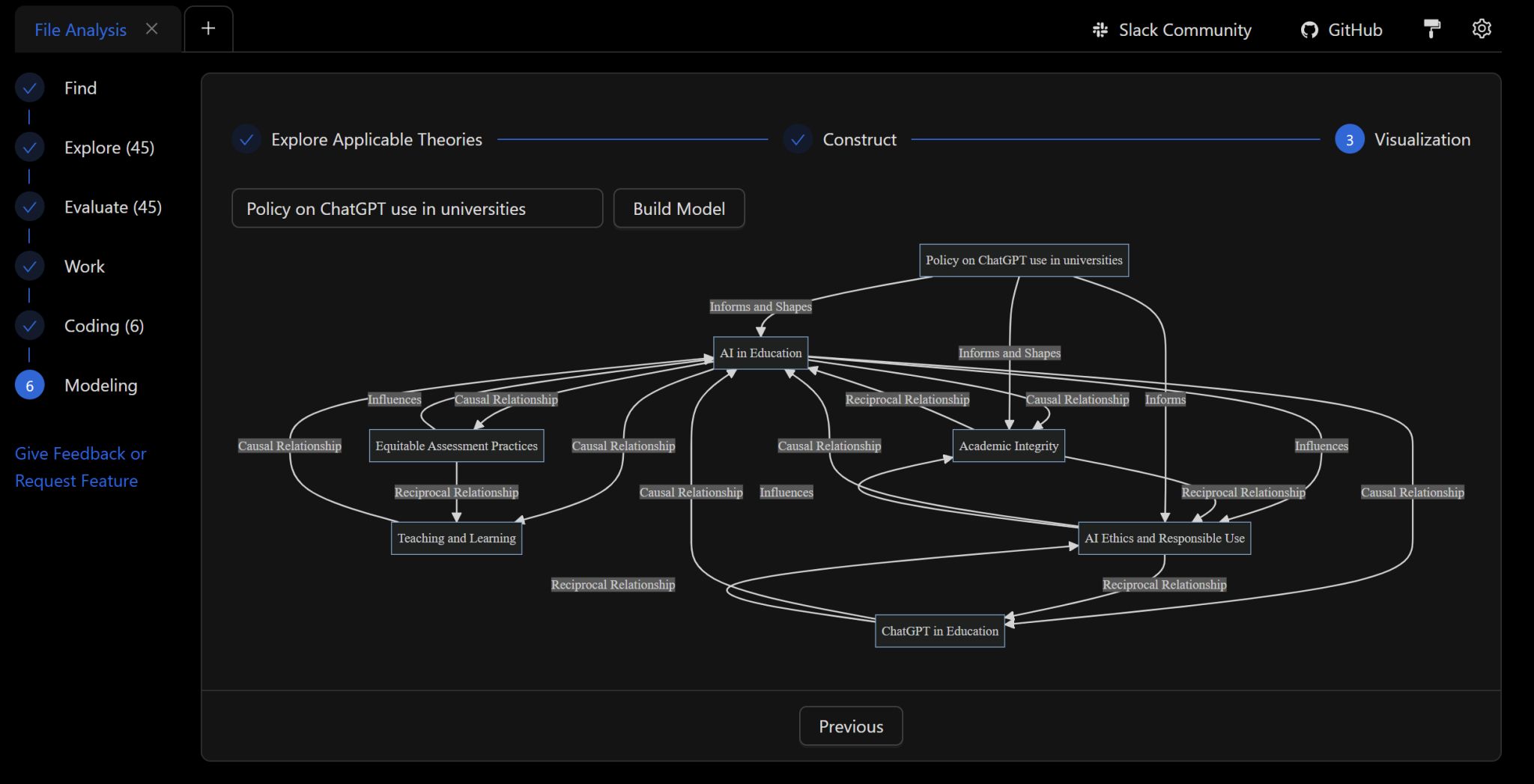
AcademiaOS uses another LLM prompt to craft a theoretical model based on these aggregate dimensions and second-order themes which explains how these synthesised concepts relate. Lastly, these theoretical models are turned into easy-to-understand MermaidJS graphs, elucidating complex theoretical relationships.
The visualization component transforms abstract theoretical relationships into intuitive, interactive diagrams that facilitate understanding and communication of research findings.
Visualization Features:
- Dynamic, interactive theoretical models
- Multiple visualization formats (network diagrams, hierarchical trees, process flows)
- Export capabilities for publications and presentations
- Real-time model refinement based on user feedback
- Integration with academic writing and presentation tools
Technological Backbone and Agile Adaptation
The backbone of AcademiaOS is a confluence of high-performance, scalable technologies, primarily utilising GPT-3.5 for NLP tasks. The platform embodies agility, poised to integrate newer and more potent LLM versions as the field evolves. This agile methodology ensures continuous refinement through user feedback, aligning the platform with the evolving needs of the academic community.
Technical Architecture
Scalable Infrastructure: Built on cloud-native architecture that can handle research projects of any size, from individual dissertations to large-scale multi-institutional collaborations.
Security and Privacy: Enterprise-grade security measures ensure that sensitive research data remains protected throughout the analysis process. Local processing options provide additional security for highly confidential materials.
Model Flexibility: The platform's modular design allows for easy integration of new AI models and techniques as they become available, ensuring that researchers always have access to cutting-edge capabilities.
Performance Optimization: Advanced caching and parallel processing capabilities ensure rapid analysis even for large datasets, dramatically reducing time-to-insight for research projects.
Quality Assurance and Validation
Methodological Rigor: AcademiaOS incorporates established qualitative research methodologies, ensuring that automated processes maintain the theoretical foundation and rigor expected in academic research.
Human-in-the-Loop: While automation drives efficiency, the platform maintains important checkpoints for human oversight and validation, preserving the critical thinking and domain expertise that human researchers provide.
Transparency and Explainability: All automated decisions and coding rationales are logged and made available to researchers, ensuring transparency in the analytical process and enabling validation of findings.
Real-World Applications and Use Cases
Qualitative Data Analysis
Researchers conducting interviews, focus groups, or analyzing textual data can dramatically accelerate their analysis timeline while maintaining methodological rigor. Case studies have shown reduction in analysis time from months to weeks without compromising quality.
Literature Reviews and Meta-Analyses
The platform's integration with Semantic Scholar enables comprehensive literature reviews that would be impossible to conduct manually within reasonable timeframes. Researchers can identify patterns across vast bodies of literature and detect emerging trends in their fields.
Mixed-Methods Research
AcademiaOS seamlessly integrates with quantitative research approaches, enabling researchers to combine qualitative insights with statistical analysis for more comprehensive understanding of complex phenomena.
Longitudinal Studies
For research projects spanning multiple years, AcademiaOS maintains consistency in coding and analysis approaches, enabling reliable comparison of findings across time periods.
Impact on Academic Disciplines
Social Sciences
In fields like sociology, psychology, and anthropology, where qualitative analysis is fundamental, AcademiaOS provides unprecedented capabilities for handling large-scale qualitative datasets while maintaining theoretical sophistication.
Business and Management Research
Case study analysis, interview coding, and theory development in management research benefit significantly from the platform's ability to identify patterns across diverse organizational contexts.
Education Research
Educational researchers can analyze student feedback, classroom observations, and policy documents more efficiently, enabling faster translation of research findings into practical educational improvements.
Health and Medical Research
Qualitative health research, including patient experience studies and healthcare delivery analysis, can be conducted more comprehensively while maintaining the nuanced understanding required in medical contexts.
Future Trajectories and Continued Innovation
While initial outcomes have been encouraging, AcademiaOS is actively exploring advanced methodologies such as vector similarity search to uncover more nuanced inter-conceptual relationships. This exploration signifies just the beginning of a broader journey in refining academic research methodologies.
Emerging Capabilities
Advanced Analytics: Integration of more sophisticated analytical techniques, including sentiment analysis, emotion detection, and cultural analysis capabilities.
Collaborative Features: Enhanced collaboration tools enabling distributed research teams to work together seamlessly on large-scale projects.
Publication Integration: Direct integration with academic writing and publication platforms, streamlining the journey from analysis to publication.
Disciplinary Specialization: Development of field-specific modules that incorporate domain knowledge and specialized analytical approaches for different academic disciplines.
Research Methodology Evolution
Hybrid Approaches: Development of new research methodologies that leverage the strengths of both human insight and machine efficiency.
Real-Time Analysis: Capabilities for analyzing data streams in real-time, enabling dynamic research approaches and immediate insight generation.
Predictive Analytics: Integration of predictive modeling capabilities to identify emerging trends and forecast research developments.
Ethical Considerations and Responsible Innovation
Maintaining Research Integrity
AcademiaOS is designed with fundamental respect for research ethics and methodological integrity. The platform augments rather than replaces human judgment, ensuring that critical thinking and domain expertise remain central to the research process.
Bias Mitigation
While human bias is reduced through automation, AcademiaOS includes specific measures to identify and mitigate algorithmic bias, ensuring that research findings remain objective and reliable.
Data Privacy and Security
The platform incorporates robust privacy protections and provides researchers with full control over their data, including options for local processing of sensitive materials.
Getting Started with AcademiaOS
Implementation Process
Organizations and individual researchers can begin using AcademiaOS through a structured onboarding process that includes:
Training and Support: Comprehensive training programs ensure researchers can effectively leverage the platform's capabilities while maintaining methodological rigor.
Pilot Projects: Initial implementations typically begin with pilot projects that demonstrate value and build confidence in the platform's capabilities.
Integration Planning: Seamless integration with existing research workflows and institutional systems.
Ongoing Support: Continuous support and platform updates ensure researchers always have access to the latest capabilities and improvements.
Success Metrics
Early adopters of AcademiaOS have reported:
- 70-80% reduction in analysis time
- Improved consistency in coding across research teams
- Enhanced ability to handle larger datasets
- Greater confidence in research findings through reduced bias
- Increased research productivity and output
Concluding Perspectives
AcademiaOS stands as a testament to the transformative potential of machine learning in academic research, particularly within social sciences. It represents not just an advancement in research methods but a paradigm shift towards a more efficient and less biased approach to academic inquiry. For researchers seeking to transcend the traditional confines of manual research processes, AcademiaOS emerges as a beacon of innovation and efficiency.
The platform exemplifies the thoughtful application of AI technology to solve real-world problems while respecting the fundamental principles and methodologies that define rigorous academic research. By automating routine tasks and enhancing analytical capabilities, AcademiaOS enables researchers to focus on what they do best: generating insights, developing theories, and advancing human knowledge.
Stay tuned for the unfolding journey of AcademiaOS, poised to redefine the landscape of academic research. The horizon is bright with the promise of innovation.
As we continue to refine and expand the platform's capabilities, we remain committed to supporting the academic community in their pursuit of knowledge and understanding. The future of academic research is here, and it's more efficient, more rigorous, and more accessible than ever before.
For further exploration and to experience the transformative power of AcademiaOS firsthand, visit AcademiaOS.